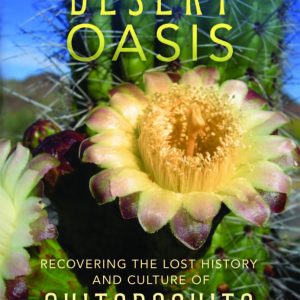
In the southwestern corner of Organ Pipe Cactus National Monument, on the border between Arizona and Mexico, one finds Quitobaquito, the second-largest oasis in the Sonoran Desert. There, with some effort, one might also find remnants of once-thriving O’odham communities and their predecessors with roots reaching back at least 12,000 years—along with evidence of their […]
Read More - Peoples of a Sonoran Desert Oasis: Recovering the Lost History and Culture of Quitobaquito
Dan Beachy-Quick writes, “There are depths within the denotative life of Greek words that English seldom allows readers in translation to access. At some basic level, I wanted to offer a translation that traced out some of those complexities into an apprehendable substance in the poems themselves—sometimes by allowing an image to unfold more fully […]
Read More - Wind–Mountain–Oak: The Complete Poems of Sappho
A special quality about the medium of virtual reality is its immersive nature, allowing users to disengage from the physical world around them in order to fully interact with a digital environment. An Artistic Approach to Virtual Reality traces the lineage of artist/technologists who have worked with virtual reality in its infancy to the interactive […]
Read More - An Artistic Approach to Virtual Reality

For three decades, Cape Town’s Magnet Theatre has served as a crucial space for theatre, education, performance and community throughout a turbulent period in South African history. Offering a dialogue between internal and external perspectives, this book analyses Magnet’s many productions and presents a rich compendium of their work. Cape Town’s Magnet Theatre has been […]
Read More - Magnet Theatre: Three Decades of Making Space

What does it mean to perform whiteness in the postcolonial era? To answer this question—crucial for understanding the changing meanings of race in the twenty-first century—Megan Lewis examines the ways that members of South Africa’s Afrikaner minority have performed themselves into, around, and out of power from the colonial period to the postcolony. The nation’s […]
Read More - Performing Whitely in the Postcolony: Afrikaners in South African Theatrical and Public Life

In this groundbreaking work, author David Scott Diffrient explores largely understudied facets of cinematic horror, from the various odors permeating classic and contemporary films to the wetness, sliminess, and stickiness of these productions, which, he argues, practically scream out for a tactile mode of textural analysis as much as they call for more traditional forms […]
Read More - Body Genre: Anatomy of the Horror Film

What do dogs mean in America? How do Americans make meaning through their dogs? The United States has long expressed its cultural unconscious through canine iconography. Through our dogs, we figure out what we’re thinking and who we are, representing by proxy the things that we don’t quite want to recognize in ourselves. Often, it’s […]
Read More - Dog of the Decade: Breed Trends and What They Mean in America

Animal disorders—those erratic, contradictory, irrational relationships that humans have with their nonhuman compatriots—abound in contemporary U.S. culture. In a series of personal essays, Deborah Thompson relates her own complicity in some of these disordered approaches to nonhuman animals, including such practices as pet-keeping, animal hoarding, animal sacrifice (both religious and scientific), magical thinking, and grieving. […]
Read More - Animal Disorders

Contradictory to its core, the sitcom—an ostensibly conservative, tranquilizing genre—has a long track record in the United States of tackling controversial subjects with a fearlessness not often found in other types of programming. But the sitcom also conceals as much as it reveals, masking the rationale for socially deviant or deleterious behavior behind figures of […]
Read More - Comic Drunks, Crazy Cults, and Lovable Monsters: Bad Behavior on American Television
